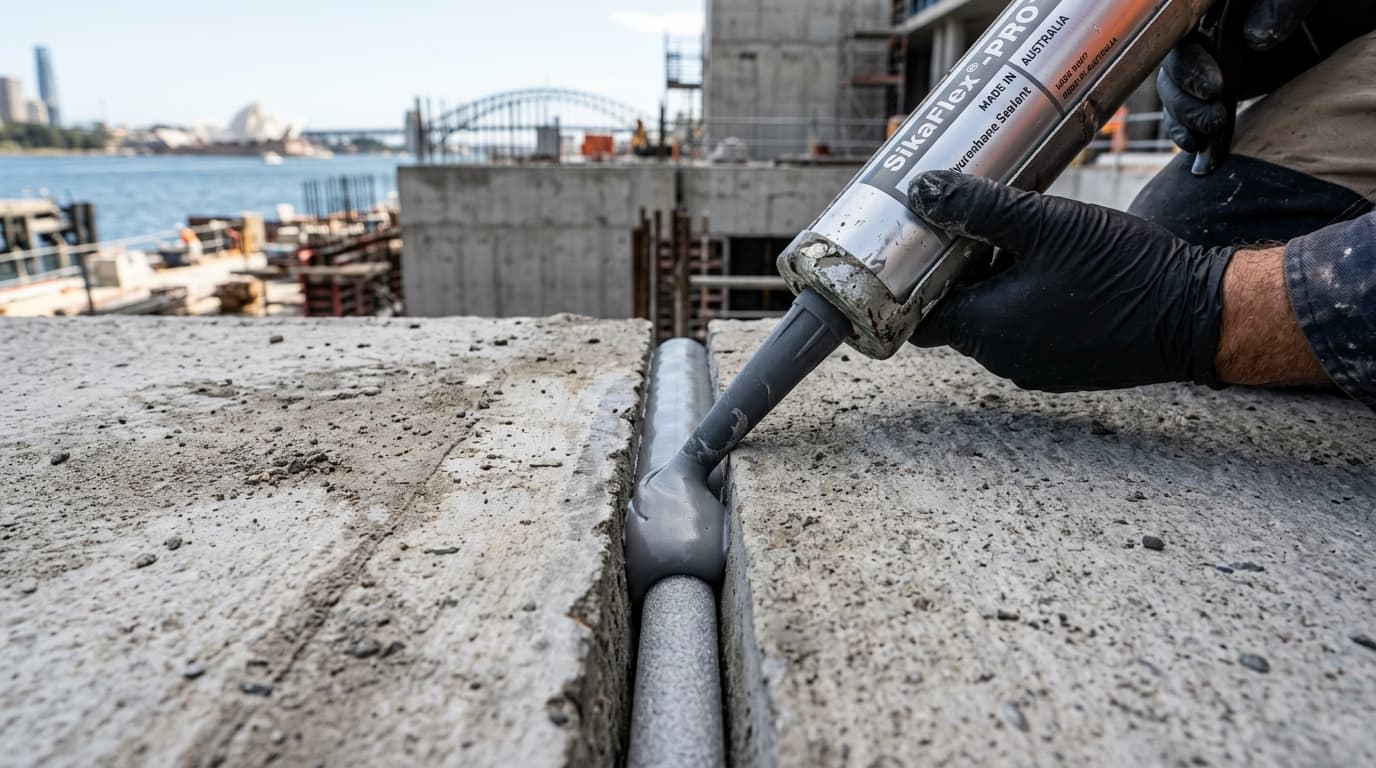
Why concrete expansion joints fail and how professional caulking protects commercial and residential buildings from structural leaks. Sizing, backing rods, and AS 1527 standards.
Why Expansion Joints Are Critical to Building Structural Health
All building materials — concrete, brickwork, steel, and stone — expand when heated and contract when cooled. In large residential complexes, commercial car parks, and precast concrete warehouses, monolithic structures would crack and buckle without engineered movement control joints.
However, an expansion joint is essentially an intentional gap cut directly through the building's exterior envelope. If the flexible joint sealant degrades or is improperly installed, wind-driven rain penetrates deep into internal structural cavities, causing steel corrosion, internal dampness, and concrete spalling.
The 2:1 Width-to-Depth Golden Rule
The single most frequent mistake made in commercial caulking is filling the entire joint cavity with sealant. In accordance with AS 1527 and sealant engineering standards:
- Joint Depth Must Equal Half the Joint Width: For a 20mm wide concrete joint, the sealant depth should be precisely 10mm (2:1 aspect ratio). For joints under 10mm wide, a 1:1 ratio is maintained.
- Closed-Cell Polyethylene Backing Rods: A round foam backing rod must be inserted into the joint before caulking. The backing rod controls the sealant depth and prevents three-sided adhesion.
- Why Three-Sided Adhesion Destroys Joints: If the sealant bonds to the back of the joint cavity as well as the two sides, it cannot stretch freely like an elastic band when the joint opens. It will tear down the center (cohesive failure) or peel off the concrete edges (adhesive failure).
Comparing Sealant Chemistries: Polyurethane vs. Silicone vs. MS Polymer
| Sealant Type | Movement Class | Paintable? | Recommended Applications |
|---|---|---|---|
| Polyurethane (PU) | Class 25 – Class 50 (±50%) | Yes | Concrete tilt-up panels, brickwork control joints, driveway saw cuts. |
| Modified Silicone (MS Polymer) | Class 25 – Class 50 | Yes | Facade cladding, composite panels, damp substrate joint sealing. |
| Neutral Cure Silicone | Class 25 | No | Glass curtain walls, sanitary perimeter joints, non-porous metals. |
Surface Preparation: The Key to 15-Year Longevity
No sealant will bond to dusty, wet, or oily concrete. JB Waterproofing's application process includes mechanical diamond blade grinding, compressed air purging, substrate priming with specialized polyurethane primers, and pneumatic sausage gun tooling with soapy profiling spatulas for a smooth concave bead.
Strata & Commercial Maintenance: Expansion joint sealants should be audited every 5 to 7 years for UV chalking, hardening, and edge debonding. Contact JB Waterproofing Solutions for a comprehensive facade caulking assessment across Greater Sydney.