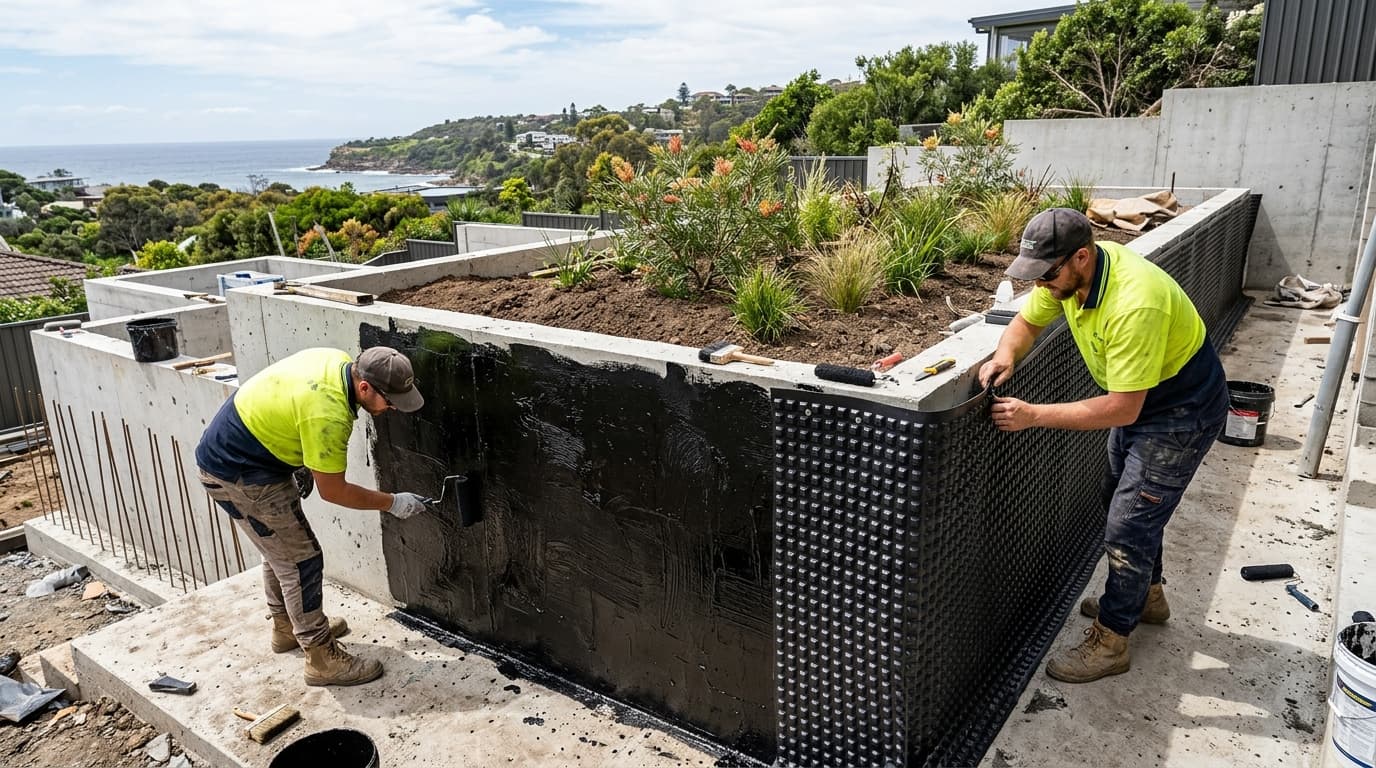
Essential technical rules for sealing concrete planter boxes and sub-ground retaining walls. Learn about anti-root chemical barriers, hydrostatic pressure, and dimple cell drainage.
The Unique Hydrostatic Challenge of Planter Boxes & Retaining Walls
Architectural planter boxes and concrete retaining walls add tremendous aesthetic value to modern Sydney homes, but they represent one of the most punishing environments for any waterproofing system. Soil constantly holds moisture against masonry walls while aggressive plant root systems exert continuous mechanical pressure searching for water.
Without specialized anti-root waterproofing and high-capacity drainage, moisture penetrates concrete pores, corrodes reinforcing steel, and leaches water into lower basements, garages, and external feature walls.
Positive vs. Negative Hydrostatic Pressure
Understanding the difference between hydrostatic pressure types is crucial for selecting the right barrier:
- Positive Side Waterproofing (External): Applied directly to the face exposed to wet soil (the inside of the planter box or the earth-retaining side of the wall). This prevents water from ever entering the concrete matrix. (Always the preferred engineering approach during construction).
- Negative Side Waterproofing (Internal Tanking): Applied to the dry interior wall face (e.g. inside a basement when the external earth cannot be excavated). Requires crystalline waterproofing slurry capable of withstanding high back-pressure.
The 4 Pillars of a Bulletproof Planter Box Installation
- Anti-Root Elastomeric Membrane: Standard bathroom polyurethane is not root-resistant. Planter boxes require certified root-barrier membranes (such as bitumen-extended polyurethanes with anti-root chemical inhibitors) that prevent root tip penetration.
- Fillet Coves & Corner Reinforcement: 90-degree internal corners must feature a 25mm radius mortar or polyurethane fillet reinforced with non-woven geotextile polyester bandage.
- High-Impact Dimple Drainage Cell (Core-Drain): Installed vertically over the cured membrane to protect it from sharp shovel impacts during gardening and create a free-draining air cavity.
- Non-Woven Geotextile Filter Fabric: Wraps the drainage cell and gravel bed to prevent soil fines from clogging the base agricultural pipe.
Safety Warning: Never plant aggressive running bamboo, ficus, or large palms in concrete planter boxes without heavy-duty polyethylene root deflector shields, as mature roots can crack 200mm reinforced concrete slabs.
Retaining Wall Agg-Pipe & Weephole Requirements
Water building up behind a retaining wall generates thousands of kilograms of hydrostatic pressure. A compliant installation must incorporate a perforated 100mm slotted agricultural drain surrounded by 20mm blue metal gravel, wrapped in geotextile socking, discharging to stormwater.